The new frontier model sets the bar for autonomous coding while democratizing advanced agent infrastructure with the Claude Agent SDK.
The new frontier model sets the bar for autonomous coding while democratizing advanced agent infrastructure
In a move that marks a decisive escalation in the AI coding war, Anthropic has released Claude Sonnet 4.5, presenting it as the world's highest-performing coding model. But beyond mere benchmark performance, this release represents something more significant: the maturation of AI from prototype generator to production-level engineer, capable of sustained autonomous work that would impress even experienced developers.
The Numbers Tell Only Half the Story
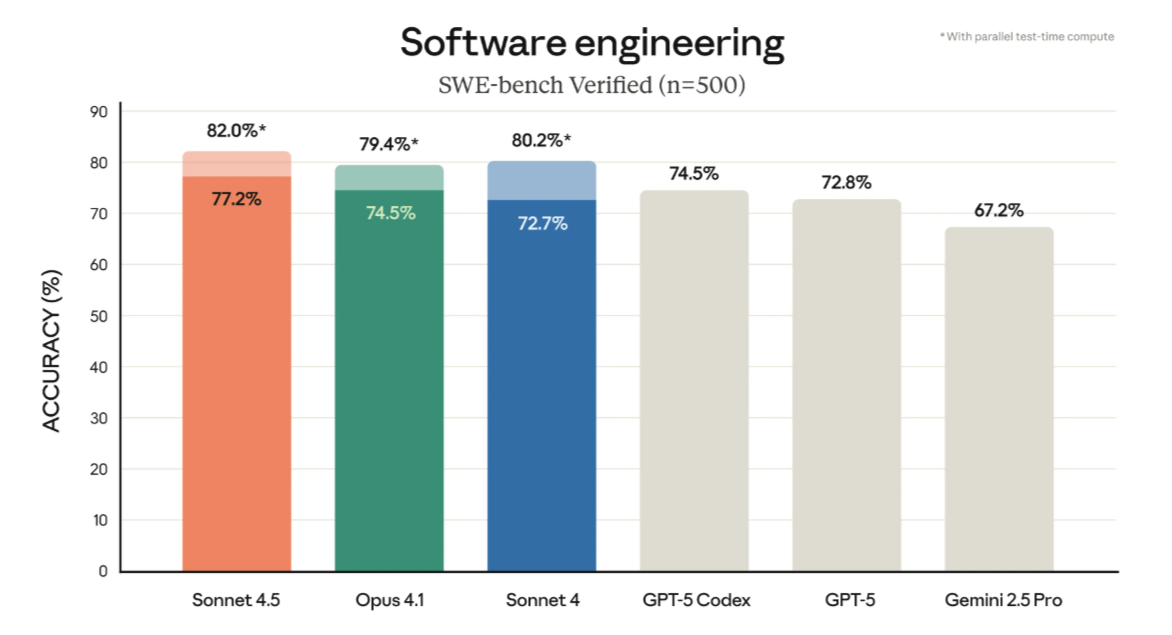
Claude Sonnet 4.5 achieves state-of-the-art performance on SWE-bench Verified, scoring 77.2% on this demanding real-world software engineering benchmark. As a reminder, this evaluation doesn't test simple code tasks: it measures an AI's ability to solve real GitHub issues from production repositories, work that typically requires deep codebase understanding and multi-step reasoning.
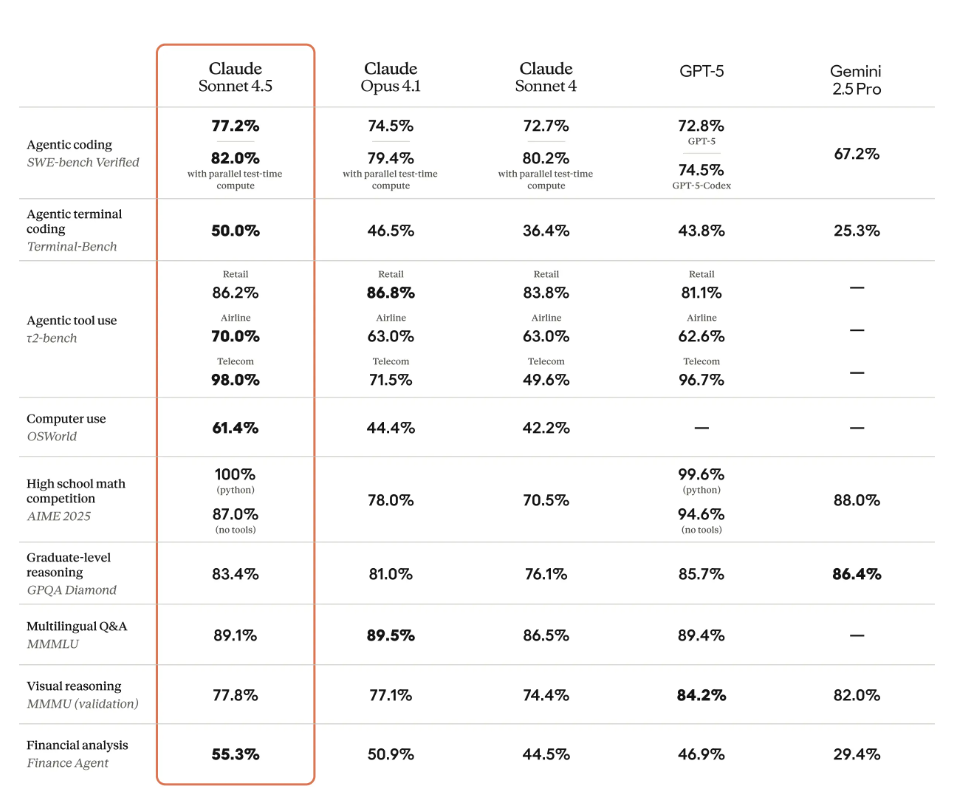
On OSWorld, which evaluates real-world computer tasks, Sonnet 4.5 leads with 61.4% — a spectacular improvement from Sonnet 4's 42.2% just four months ago. This represents much more than incremental progress: it's a fundamental expansion of what AI can reliably accomplish in complex, open-ended environments.
But here's what benchmarks don't capture: during early enterprise trials, Anthropic researchers observed Claude Sonnet 4.5 coding autonomously for over 30 hours, not only writing code but also setting up database services, purchasing domain names, and performing SOC 2 security audits. This is no longer just an AI assistant — it now approaches the capabilities of a junior engineer working independently on substantial projects.
Why This Matters for Developers
The AI coding tool ecosystem has rapidly consolidated around Claude as the reference inference engine. Major platforms like Cursor, Windsurf, and Replit rely on Claude models, and Michael Truell, CEO of Cursor, particularly praised Sonnet 4.5's performance on long-horizon tasks. The enthusiasm is justified: when an AI can maintain context and focus during multi-hour coding sessions, it stops being just a sophisticated autocompleter and becomes a true collaborative partner.
Pricing remains competitive at $3 per million input tokens and $15 per million output tokens, identical to the previous Sonnet 4 model. For developers, this means much more capability at the same cost — a rarity in enterprise software.
The model also shows marked improvements in reasoning and mathematics, with domain experts in finance, law, medicine, and sciences reporting specialized knowledge far superior to previous models, including the larger Opus 4.1.
The Claude Agent SDK: Opening the Black Box
Perhaps even more significant than the model itself is what Anthropic is releasing alongside it. The Claude Agent SDK represents a strategic pivot: making available to developers the proprietary infrastructure that powers Claude Code, enabling them to build their own autonomous agents.
This isn't just middleware. In six months of developing Claude Code, Anthropic has solved fundamental agent architecture challenges: memory management for long-running tasks, permission systems balancing autonomy with user control, and coordination of multiple sub-agents working toward common goals. These are the unglamorous but crucial problems that determine whether an AI agent is a reliable tool or a random experiment.
The SDK provides:
- Memory systems allowing agents to retain context over long operations without losing sight of their objectives or previous decisions — essential for tasks spanning hours rather than minutes.
- Permission frameworks giving developers the ability to define guardrails for agent behavior, crucial for production deployment where unlimited AI autonomy would be untenable.
- Multi-agent coordination, enabling complex workflows where specialized sub-agents handle different aspects of a problem while maintaining overall coherence.
While the SDK powers Claude Code's impressive coding capabilities, Anthropic emphasizes that it demonstrates its utility across a wide range of tasks beyond software engineering. It thus positions itself as foundational infrastructure for the next generation of AI applications, not just coding tools.
For developers who have experimented with building agents using raw LLM APIs, the difference is stark. The SDK handles the technical complexity that typically consumes 80% of development time, allowing creators to focus on domain-specific problems rather than reinventing agent infrastructure.
Strategic Implications for Versatik's Voice AI Development
For Versatik, the convergence of Claude Sonnet 4.5 capabilities and the Agent SDK represents a transformative opportunity in voice agent development. Building sophisticated voice agents requires solving precisely the challenges addressed by the SDK: maintaining conversational context over long interactions, state management across multi-turn dialogues, and coordination between speech recognition, language understanding, and response generation.
The SDK's memory management capabilities are particularly crucial for voice applications, where users expect the agent to remember context from previous exchanges without explicit reminders. Unlike text interactions where you can scroll through history, voice is ephemeral — the agent must maintain perfect continuity or break the experience. Permission frameworks allow Versatik to build voice agents capable of acting autonomously while respecting necessary boundaries, crucial for enterprise deployments where voice agents may process sensitive data.
Furthermore, Claude Sonnet 4.5's improved reasoning and specialized knowledge mean that voice agents can handle more complex queries without relying on scripted responses or failing awkwardly. Its ability to maintain focus for 30 hours translates directly to voice agents capable of managing long tasks initiated via the conversational interface — imagine a voice agent capable of launching a multi-step business process and tracking its progress for hours or days, providing status updates naturally.
Multi-agent coordination functions open the path to sophisticated voice architectures where specialized sub-agents handle different aspects of the interaction — one for intent recognition, another for knowledge retrieval, another for task execution — all orchestrated via the SDK while presenting a unified conversational interface to the user. This is no longer just about building better voice chatbots, but creating voice agents capable of truly understanding, reasoning, and acting on behalf of users in production.
Alignment Gains: The Critical but Quiet Work
Anthropic claims that Claude Sonnet 4.5 is its most aligned frontier model, showing substantial improvements in reducing sycophancy, deception, power-seeking, and encouragement of delusional thinking. For agentic applications — where AI makes decisions and acts with limited supervision — alignment is not a philosophical luxury, it's a prerequisite for reliable deployment.
The company has also made considerable progress in defending against prompt injection attacks, one of the most serious risks for AI systems capable of using computers. As agents gain the ability to browse the web, execute code, and interact with APIs, prompt injection becomes an attack vector with very real consequences.
The Competitive Landscape
Anthropic's release comes as OpenAI's GPT-5 has challenged Claude's dominance, outperforming previous models on various coding benchmarks. The timing suggests Anthropic isn't ready to cede ground in what has become its key market position.
The stakes are high. Apple and Meta are reportedly using Claude internally, and Anthropic has built a significant portion of its business by selling API access to its AI coding applications. Maintaining its technological leadership isn't just about image — it's directly tied to Anthropic's commercial viability in an increasingly competitive landscape.
What This Makes Possible
The combination of Sonnet 4.5 capabilities and the Agent SDK opens new possibilities for autonomous software development:
- Multi-day projects: Agents capable of maintaining context and focus over long periods can tackle entire features or refactorings that previously required human supervision at every step.
- Infrastructure management: The ability not only to write code but also to provision services, configure databases, and set up security controls means AI can handle more of the end-to-end software lifecycle.
- Specialized agents: Thanks to the SDK's coordination capabilities, developers can create teams of specialized agents — one for frontend, another for backend, another for testing — that collaborate like human teams.
The Way Forward
Anthropic is also launching "Imagine with Claude," a five-day research preview where AI generates software on the fly without predetermined features. Presented as a demonstration, it's also a glimpse of a possible future where software creation would become much more fluid and responsive.
The broader implication is clear: we're moving beyond AI as a mere coding assistant toward AI as an autonomous software engineer. Not in the hyperbolic sense of replacing human developers, but in the practical sense where it independently takes on increasingly substantial portions of the development process.
For developers, the opportunity lies not just in productivity gains — though those are real. It's about elevation. When AI can reliably handle the mechanical aspects of software development, human developers can focus more on system design, architecture choices, and creative problem-solving that remain uniquely human.
---
Build Your AI Agents with Versatik
We design voice agents and automation solutions leveraging the latest AI advances, including Claude Sonnet 4.5 and the Agent SDK.
Contact Versatik