By Versatik · March 2026
Your campaigns generate leads. But how many turn into actual revenue? The answer depends less on how fast you call — and more on how intelligently you follow up.
The Speed-to-Lead Myth: Why Calling Fast Isn't Enough
Every marketer has heard the statistics. Responding within the first minute boosts lead conversions by 391%. Wait five minutes, and the odds of qualifying a lead plummet by 80%. Contact a lead within five minutes and you're 21 times more likely to qualify them than if you wait 30 minutes — and 100 times more likely to even get them on the phone. The data is clear: 78% of customers buy from the first company to respond.
But here's the uncomfortable truth: speed alone doesn't close deals. The average lead-to-sale conversion rate across industries sits between 2% and 5%. Over 30% of leads are never contacted at all, wasting billions in marketing spend. And yet, the average lead response time across industries exceeds 40 hours. The problem isn't just delay — it's the complete absence of strategy after the first call.
Why Generic AI Lead Callers Fall Short
Most AI lead calling solutions on the market today operate on a simple loop: lead comes in → AI calls → asks 2–3 questions → logs result → sends an email. They are essentially automated dialers with a conversational interface. This approach has several blind spots.
One Script Fits All
Generic platforms apply the same script whether the lead came from a Facebook ad for a free audit, a Google Search query with high purchase intent, or a LinkedIn form fill from a C-level executive. A lead from Google Search who typed "HVAC emergency repair near me" has fundamentally different intent than someone who clicked a Facebook ad offering a free guide. Treating them identically wastes the high-intent lead's time and under-serves the low-intent one.
No Sector-Specific Intelligence
A real estate lead needs to be asked about location, budget, timeline, and whether they're buying or renting. An insurance lead requires eligibility gatekeeping, coverage classification, and regulatory-compliant questioning. A SaaS prospect needs qualification on company size, use case, and decision-making authority. Generic platforms force businesses to retrofit their qualification logic into a one-size-fits-all framework.
Missing Compliance Layer
For any business operating in Europe, GDPR compliance isn't optional. AI voice agents must identify themselves, obtain explicit consent before data collection, apply data minimization principles, and allow users to access or delete their data. Few generic AI lead callers address this natively — and for companies running campaigns across EU markets, this is a dealbreaker.
The "Orchestrated Callback" Approach: Speed to Lead 2.0
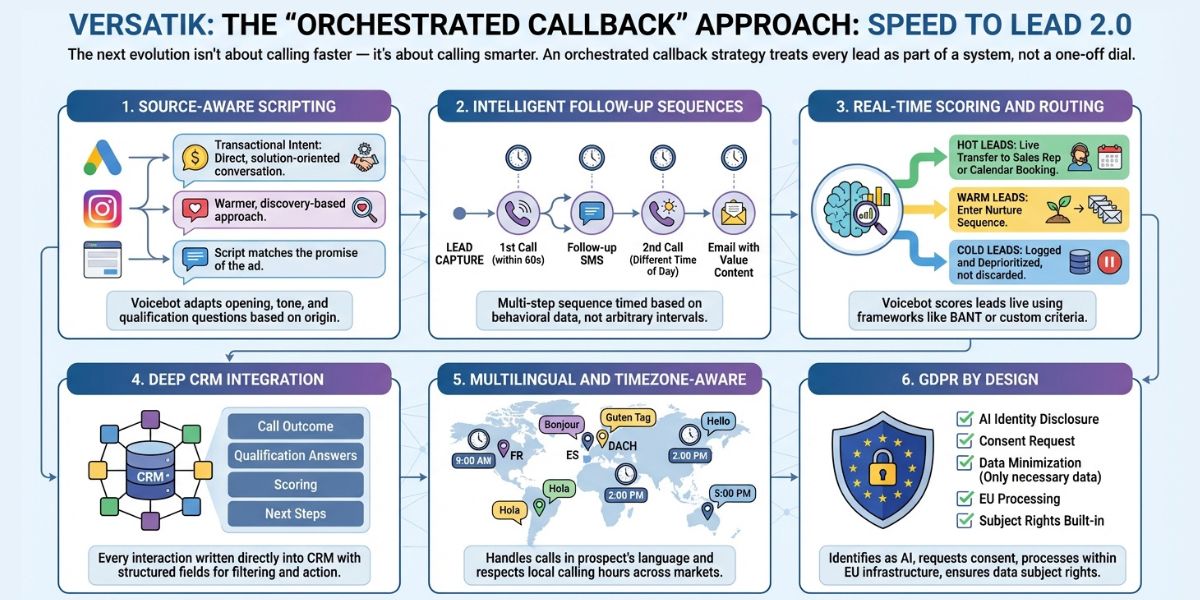
The next evolution isn't about calling faster — it's about calling smarter. An orchestrated callback strategy treats every lead as part of a system, not a one-off dial. Here's what that looks like in practice.
Source-Aware Scripting
The voicebot adapts its opening, tone, and qualification questions based on where the lead came from. A lead from Google Ads with transactional intent gets a direct, solution-oriented conversation. A lead from Instagram gets a warmer, discovery-based approach. The script matches the promise of the ad that generated the lead.
Intelligent Follow-Up Sequences
Instead of "call once, email once, move on," a smart voicebot orchestrates a multi-step sequence: first call within 60 seconds, then a follow-up SMS if no answer, then a second call attempt at a different time of day, then an email with value content. Each step is timed based on behavioral data, not arbitrary intervals.
Real-Time Scoring and Routing
During the conversation, the voicebot scores the lead in real time using frameworks like BANT (Budget, Authority, Need, Timeline) or custom criteria. Hot leads are transferred live to a sales rep or get a calendar booking. Warm leads enter a nurture sequence. Cold leads are logged and deprioritized — but not discarded.
Deep CRM Integration
Every interaction — call outcome, qualification answers, scoring, next steps — is written directly into the CRM with structured fields, not just a text summary. This means sales teams can filter, sort, and act on leads without re-qualifying them manually.
Multilingual and Timezone-Aware
For businesses operating across markets (France, Spain, DACH, UK...), the voicebot should handle calls in the prospect's language and respect local calling hours. This isn't a nice-to-have — calling a French prospect at 9 PM or speaking English to a Spanish-speaking lead kills conversion.
GDPR by Design
The voicebot identifies itself as an AI assistant at the start of every call, requests consent before proceeding, collects only the data necessary for qualification, and logs consent status in the CRM. Data is processed within EU infrastructure, and data subject rights (access, deletion, portability) are built into the system from day one.
Use Case 1: Home Services (HVAC, Plumbing, Electrical)
The Problem
A mid-sized HVAC company runs Google Ads campaigns for emergency repairs and seasonal maintenance. Leads fill out a form or call during business hours, but 35% of inquiries go unanswered after hours or during peak times. Every missed call is a lost job worth $200–$800.
How the AI Voicebot Steps In
The moment a lead submits a form — whether at 2 PM or 2 AM — the voicebot calls back within 60 seconds. It identifies itself and asks targeted questions: What's the issue? Is this an emergency or routine maintenance? What's your address? When are you available?
The voicebot checks the address against the company's service zone. If the lead is in-zone, it queries the technician calendar in real time and proposes available slots: "We have availability tomorrow at 1 PM or Thursday morning at 9 AM. Which works better for you?". It confirms the appointment, sends an SMS with technician details and a two-hour arrival window, and creates a CRM record with a lead score.
If the call goes to voicemail, the voicebot leaves a brief message and triggers an automated SMS: "Hi [Name], we received your request for [service]. Call us back at [number] or reply to this text to schedule."
The Result
Case studies from HVAC companies using similar AI voice systems show a 37% increase in lead-to-appointment conversion, a 214% improvement in after-hours appointment booking, and a 40% increase in revenue per lead within 90 days. Office staff are freed from routine scheduling and can focus on complex customer issues.
Use Case 2: Real Estate Agencies
The Problem
A real estate agency spends €5,000–€15,000/month on Facebook and Google Ads for property listings. Leads pour in — but agents are at showings, on calls, or off for the day. By the time they call back, the prospect has already spoken to three other agencies. The first responder wins the listing appointment 78% of the time.
How the AI Voicebot Steps In
When a lead submits a form from a paid ad — "Interested in 3-bedroom apartments in the 15th arrondissement" — the voicebot calls within 60 seconds with context from the form. It engages naturally: "Hi Marie, thanks for your interest in properties in the 15th. I have a few quick questions to match you with the right listings."
The voicebot qualifies across key dimensions: current location, buying vs. renting intent, budget range, timeline ("Are you looking to move within the next 3 months?"), specific requirements (parking, school proximity, pet-friendly), and whether the prospect is pre-approved for financing.
Qualified leads are either transferred live to an available agent or booked directly into the agent's calendar for a showing or consultation call. The CRM is updated with all qualification data, tagged by source campaign and lead score.
For leads who don't pick up, the voicebot enters a follow-up sequence: second call attempt 2 hours later, then an SMS with a link to matching property listings, then a third call the next morning.
The Result
Real estate teams using AI voice callbacks report 100% of new leads contacted within 2 minutes, 3x more property visits booked, and 5x more qualified appointments scheduled. Sales reps save an average of 5 hours per day previously spent on manual outreach and phone tag.
Use Case 3: Marketing Agencies and Consulting Firms
The Problem
A digital marketing agency runs its own lead generation campaigns (Facebook Ads, LinkedIn Ads) to sell SEO, paid media, or web design services. Leads request a "free audit" or "strategy session." But the founder and two sales reps are already on client calls all day. Response time averages 4–6 hours. By then, the prospect has booked a call with a competitor — or forgotten they even filled out the form.
How the AI Voicebot Steps In
The voicebot is triggered the instant a lead submits a form from any ad platform. It adapts its script based on the campaign: a lead from a "free SEO audit" campaign gets a different opening than one from a "scale your ads" campaign.
The voicebot qualifies using agency-specific criteria: "What's your current monthly ad spend?" "How many people are on your marketing team?" "Are you the decision-maker for marketing investments?" "What's your biggest challenge right now — traffic, leads, or closing?"
If the lead scores above the threshold, the voicebot books a strategy call directly into the founder's or sales rep's calendar: "Great — based on what you've told me, I think a 20-minute strategy call with our team would be really valuable. I have availability tomorrow at 10 AM or Thursday at 3 PM. Which works better?"
Leads that don't meet minimum criteria (too small, no budget, not decision-maker) receive a polite disqualification and are added to a nurture email list instead of wasting the sales team's time.
The Result
Agencies implementing AI lead calling report 20% or higher conversion rates from lead to booked call. Sales teams spend less time qualifying and more time closing. The instant response also reinforces the agency's brand promise: if they can't respond to their own leads fast, why would a client trust them to manage theirs?
Use Case 4: Coaching, Training, and High-Ticket Services
The Problem
A business coach sells a €5,000–€15,000 coaching program. Leads come from webinar funnels, Instagram content, and Facebook Ads offering a "free discovery call." The coach does everything themselves — content creation, client sessions, admin — and simply cannot call back 30+ leads per week within 5 minutes. Conversion from lead to booked call sits at 12%, and no-show rates are high because leads book a call days after their initial interest has cooled.
How the AI Voicebot Steps In
The voicebot calls each new lead within 60 seconds of their opt-in. It follows a structured qualification framework designed for high-ticket sales:
- Situation: "Can you tell me a bit about your current business or role?"
- Pain: "What's the biggest challenge you're facing right now that led you to reach out?"
- Budget readiness: "Have you invested in coaching or training programs before? What range are you comfortable with?"
- Timeline: "How soon are you looking to get started?"
- Decision authority: "Is this a decision you can make on your own, or do you need to involve a partner or team?"
Leads that hit all qualification criteria get booked immediately into the coach's calendar with a pre-call summary. The coach walks into the call already knowing the prospect's situation, pain points, budget range, and readiness — turning a 45-minute discovery call into a 20-minute closing conversation.
Leads that don't qualify are redirected to a lower-ticket offer (online course, group program) or added to a nurture sequence with value content.
The Result
The immediate callback captures the lead at peak emotional engagement — right after they've watched a webinar or consumed a piece of content that resonated. Qualification rates climb because the voicebot applies criteria consistently, unlike human SDRs who may skip questions or get swayed by charm. No-show rates drop because the gap between interest and booking shrinks from days to minutes.
Use Case 5: Insurance and Financial Services
The Problem
An insurance brokerage generates leads through comparison sites, Google Ads, and partner referrals. Volume is high — 200+ leads per week — but only 15–20% are genuinely qualified. SDRs burn through the list manually, spending most of their time on leads who were just browsing, already have coverage, or don't meet eligibility criteria. Meanwhile, high-intent leads who submitted a form at 7 PM sit untouched until 10 AM the next morning.
How the AI Voicebot Steps In
The voicebot engages every lead instantly, 24/7, with an insurance-aware qualification framework. It classifies intent using semantic signals rather than menu selections — phrases about family changes, vehicle purchases, homeownership, or upcoming renewals route the conversation into the right product branch automatically.
The voicebot checks eligibility in real time: age bands, geographic coverage, policy tenure, and basic underwriting constraints are verified during the call. Leads that don't meet hard eligibility thresholds are filtered before reaching a human agent, preventing wasted sales effort.
For qualified leads, the voicebot scores readiness using progressive signals — commitment language, answer specificity, and response latency. Clear, direct answers strengthen the readiness score; vague or hesitant responses lower it without disqualifying prematurely. Once a readiness threshold is crossed, the voicebot either transfers the call live to an available agent or books a callback at the prospect's preferred time.
A compressed handoff packet — containing resolved qualification fields, unresolved flags, and recommended next actions — is injected into the agent's screen before they pick up, so they never start a call cold.
Every interaction is fully logged with call recording, transcript, qualification data, and consent status. Scripts include mandatory compliance disclosures, and the system tracks consent rates and disclosure completion rates through analytics dashboards.
The Result
Insurance companies using voice AI for lead qualification report that sales queues receive only leads that satisfy product fit, eligibility, and compliance requirements. Agent productivity increases dramatically because they no longer spend time re-screening leads that were never viable. The 24/7 availability captures high-intent evening and weekend leads that would otherwise be lost to next-day follow-up delays.
What to Look For in a Smart AI Voicebot
Not all AI lead callers are created equal. When evaluating solutions, the following capabilities separate a basic auto-dialer from a true conversion engine:
| Capability | Basic AI Lead Caller | Smart AI Voicebot |
|---|---|---|
| Response time | < 5 minutes | < 60 seconds |
| Script customization | One script for all leads | Source-aware, campaign-specific scripts |
| Follow-up logic | 1–2 attempts, fixed intervals | Multi-step sequences, time-optimized |
| Lead scoring | Binary (qualified/not) | Real-time scoring with thresholds and routing |
| CRM integration | Email summary or webhook | Structured field mapping, status updates |
| Sector adaptation | Generic questions | Vertical-specific frameworks (BANT, insurance, real estate) |
| Multilingual | English only or limited | Native multilingual with local number support |
| Compliance (GDPR) | Not addressed | Built-in consent, data minimization, EU hosting |
| Voicemail handling | Hangs up | Leaves message + triggers SMS/email sequence |
| Human handoff | Email notification | Live transfer with context packet |
The Versatik Approach: Orchestrated Intelligence, Not Just Speed
The Call-your-leads service by Versatik was built around the orchestrated callback philosophy. Rather than competing on who dials fastest, the platform focuses on what happens during and after that first call — and every interaction that follows.
The system connects to all major lead sources (Facebook Ads, Instagram Ads, LinkedIn Ads, Google Ads, website form) and triggers a personalized voicebot within 60 seconds. Each voicebot is configured with campaign-specific scripts, vertical-specific qualification logic, and multi-step follow-up sequences. CRM synchronization happens in real time with structured data — not just a text blob.
For European businesses, GDPR compliance is native: AI identification at call start, explicit consent capture, data minimization, EU-based processing, and full data subject rights support.
The result is a system where every euro spent on acquisition works harder — because no lead is wasted on slow response, bad qualification, or missing follow-up.
Ready to see how an orchestrated AI callback strategy could recover lost revenue from your existing campaigns? Request a free audit of your current lead response process →